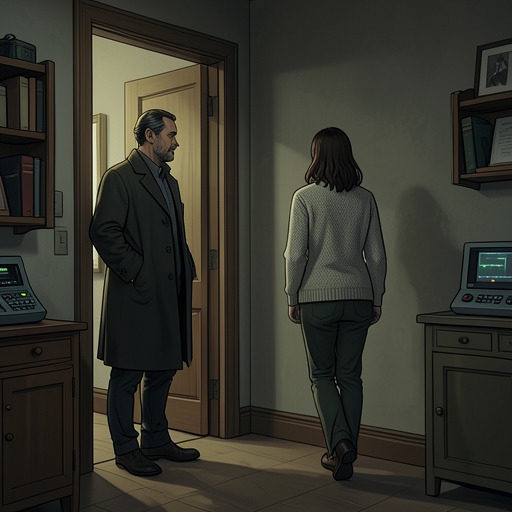
Bernadette Falls Asleep at the Pharmacy, Worrying Elgin
Where'd You Go BernadetteBernadette Falls Asleep at the Pharmacy, Worrying Elgin is the moment an errand for medication becomes a visible sign of crisis. In a cavernous, wood-paneled compound pharmacy, Bernadette is left waiting for a prescription while struggling with exhaustion; Elgin then finds her asleep on a sofa, wearing a fishing vest. Her casual explanation does not reassure him. The encounter leads him to question her about the medication, discover a cabinet of empty prescription bottles, and seek professional advice about treatment and involuntary commitment.
The Pharmacy and the Prescription
The pharmacy’s setting is as disorienting as the errand: it has poorly stocked shelves, a brocade sofa, and a Chihuly chandelier. Bernadette approaches the counter and gives her name. A pharmacist tells her that the prescription is for ABHR, a compound containing Haldol along with Benadryl, Reglan, and Ativan. He explains that Haldol is an antipsychotic and describes its use in the Soviet prison system. The information makes the medication sound alarming, but Bernadette responds that it sounds good to her.
The stated purpose of the prescription is unclear. The pharmacist says it was written for seasickness in anticipation of a cruise, and Bernadette says she is going to Antarctica over Christmas and must cross the Drake Passage. She describes the trip’s daunting swells and speed of the water, while admitting she is trying to block out the details and blaming her daughter for the journey. Later, when Elgin asks about the medicine, Bernadette says it was prescribed for anxiety. The discrepancy between the pharmacist’s account and hers remains unresolved, adding uncertainty to an episode already marked by exhaustion and confusion.
Elgin Finds Bernadette Asleep
While waiting, Bernadette sits on the pharmacy’s brocade sofa and falls asleep. Elgin comes upon her there while walking to lunch with colleagues. He is struck by the incongruity: she is asleep in public, wearing a fishing vest, despite her usual insistence on stylish clothes and her criticism of other people’s fashion. She tells him she is waiting for Xanax because the pharmacy would not give her Haldol. Elgin asks what she is wearing and whether she can stand up; he has a lunch to attend and asks if he should cancel it.
Bernadette says she is fine, explains that she did not sleep the night before, and urges him to go. Elgin says he will come home for dinner and asks whether they can eat out. His discovery changes the meaning of the errand: what might have seemed like a peculiar clothing choice or a brief nap now sits alongside her sleeplessness and her matter-of-fact expectation of receiving an antipsychotic. He is sufficiently alarmed to rearrange his plans so the two of them can talk.
The Dinner and the Empty Bottles
At dinner, Elgin tries to ask about the medicine. Bernadette initially turns their conversation toward observations about tattoos and fashion, including a tattoo of a paper clip and another depicting Scotch tape. The digressions delay his question, but he returns to it: he wants to know about the medicine the pharmacy would not fill. Bernadette confirms that a doctor wrote the prescription and that it turned out to be Haldol. Elgin asks whether the prescription is connected to her insomnia and whether she is seeing a psychiatrist. She says it was for anxiety and answers no when he asks about psychiatric care.
After they return home, Elgin waits until Bernadette is asleep before opening her medicine cabinet. It contains prescription bottles from an array of doctors, including Xanax, Klonopin, Ambien, Halcion, and trazodone; all the bottles are empty. The discovery gives his worry a concrete basis beyond what he saw at the pharmacy. Yet it does not provide a diagnosis. In his account to Dr. Kurtz, Elgin wonders whether Bernadette is depressed, manic, dependent on pills, or paranoid, and acknowledges that he does not know what constitutes a mental breakdown. He concludes that she needs serious attention, but his uncertainty remains part of the episode rather than being resolved by the medication list.
Concern, Care, and the Question of Compulsion
Elgin writes to Dr. Kurtz because he is considering what kind of help Bernadette needs. He suggests that she might enter Madrona Hill while he and their daughter go to Antarctica, describing the proposed stay as supervised rest. Dr. Kurtz’s reply makes plain that this could amount to detention against Bernadette’s will. Under the Washington Involuntary Treatment Act, a designated mental-health professional must assess whether a person, because of psychiatric illness, presents an imminent danger to themselves, other people, or property. An involuntary hold requires emergency assessment and can suspend civil liberties; an initial hold may last up to seventy-two hours before the courts become involved.
The pharmacy incident therefore leads beyond concern about a single drug or a lost night of sleep. Elgin wants Bernadette to receive care, but the possible route he considers carries consequences for her liberty and for the family. Later, when he presses for inpatient treatment on the basis of an FBI file, Dr. Kurtz expresses concern about his determination and gives him names of psychiatrists instead. The episode’s significance lies in this unsettled divide: Bernadette’s distress is visible in the pharmacy, in the sleeplessness and empty bottles, and in Elgin’s alarm, while the evidence does not itself settle either a diagnosis or the legitimacy of coercive treatment.